


Language instructs us in how we understand the world. Some languages instruct us to do something. Some language informs us of what has occurred. And some languages provide us with questions. Curious is one of them.
Putting curiosity in a sentence is not simply defining emotion. It is opening a door. It is demonstrating willingness to know, the flame to ask, the agony to know.
Picture children gazing up at the stars. Wide eyes. Round hearts. That’s curiosity at its simplest. But curiosity doesn’t stop there. Adults use it too—when searching for meaning, when questioning assumptions, when being brave enough to know more. This guide will demonstrate how to use curiosity in a sentence with power, with warmth, with conviction.
What Does Curious Mean
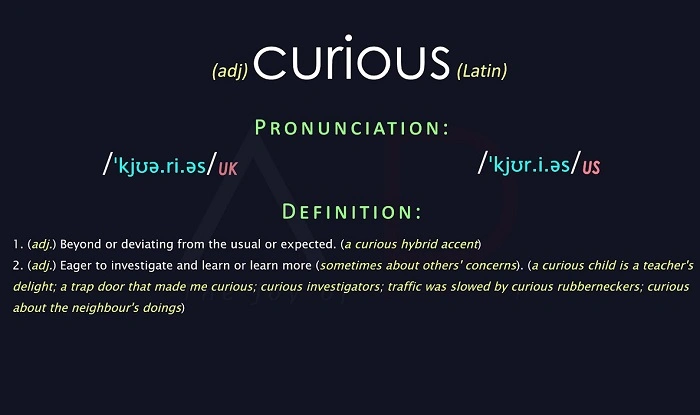
Curious is an adjective. Basically, it means being interested in knowing or learning. But then there’s another sense of it: strange, odd, or unexpected.
- To be curious: She is curious about science.
- Odd: That is a curious design.
- Showing interest: I am curious to know your opinion.
So curious has two faces. One of inquiry, one of surprise.
How to Use Curious in a Sentence
The design is minimal, but the impact is strong.
Formula: Subject + is/was + curious about/curious to + action or idea
- She is curious about space exploration.
- He was curious to know more about her story.
- They were curious about the outcome of the game.
- I’m curious to see how this ends.
It also works when describing something strange:
- The artifact had a curious shape.
- It was a curious coincidence.
Everyday Examples of Curious
You use and hear curiosity daily, even inadvertently. Here are some spontaneous examples:
- Kids are curious about anything.
- I am curious to go to the new restaurant.
- He stared at the curious design on the wall.
- I was curious to see her response.
- That is a curious solution to the problem.
Observe how the word works in both informal conversation and careful consideration.
Why Use Curious Instead of Simple Words
Because curiosity is subliminal. It is not complimentary. It signals hunger. A pull. A flash.
- It is more civilized. “I want to know” is flat. “I am curious” has cadence.
- It is memorable. It suggests openness and interest.
- It is revealing. It turns the tables on the contrast between interest and real fascination.
When you use curiosity in a sentence, you add depth of vitality to your vocabulary.
Synonyms and Related Words
Curious has friends, and the other colors are those friends.
- Inquisitive
- Interested
- Nosy
- Inquiring
- Fascinated
Examples:
- The child was curious about the stars.
- She was interested in art history.
- He was nosy about his neighbor’s life.
See the difference. Inquisitive is neither good nor bad. Nosy is bad. Curious lives on both sides.
Curious in Literature and History
Authors love this word because it has wonder and strangeness in it simultaneously.
- Alice’s Adventures in Wonderland was penned by Lewis Carroll, and Alice said, “Curiouser and curiouser!”
- Philosophers name human beings curious, always asking questions.
- Historians document curious findings that changed the world.
Curiosity is ageless. It also falls into discovery fiction and mystery fiction.
Curious in Real Life
Innovation stems from curiosity. All inventions, breakthroughs, and scientific breakthroughs began with an inquiring mind.
- A curious scientist who gazes at the stars builds telescopes.
- A curious artist of form creates new shapes.
- A curious child about bugs becomes a biologist.
Curiosity enriches life with connection and dialogue.
“I’m curious about your day.”
“I’m curious to hear what you think.”
“I’m curious why you took that route.”
It shows interest. It builds connection.
Mistakes with Curious
- Limiting its use to kids. Adults are curious, too.
- Using it synonymously with nosy. Nosiness is intrusive. Curiosity is okay.
- Overlooking its secondary connotation. Curious can also be strange too, though not necessarily questioning.
Examples:
- Wrong: Only children are curious.
- Right: People of all ages are driven by curiosity.
Business Use of Curious
Being curious is empowering in the workplace and at school.
At work:
- Employers want employees who are questioning and curious.
- Innovation takes place because teams that are curious enough question assumptions.
At school:
- Curious students learn more effectively.
- Teachers create curiosity by discovery.
In health:
- A curious doctor uncovers the cause of illness.
- A curious patient is a healthier habit.
Employing curiosity as a sentence in the workplace, you are singling out growth, openness, and learning.
Emotional Vulnerability of Curious
Curious is an emotional adverb because it’s an act of vulnerability. To say “I’m curious” is demonstrating that you are embracing you don’t know everything. It’s an act of open-mindedness.
- “I’m curious about your story” → You care.
- “I’m curious what you think” → You care what they think.
- “I’m curious about the future” → You admit hope and curiosity.
Curiosity is attention dressed as love. It’s fascinating at a personal level.
Practice Sentences with Curious
Do it yourself with these simple steps.
Step 1: Write a plain idea.
Step 2: Put in curiosity to make it more interesting.
Step 3: Speak it out.
Examples:
- He wants to know → He is curious to know.
- She looked at the thing → She looked at the curious thing.
- They are waiting for the result → They are eagerly waiting to hear the result.
Practice daily until it becomes second nature.
Outside People
Curious is not only used for people, but also for things, events, or trends.
- The painting had a curious light.
- The cat exhibited curious behavior.
- It was a fascinating meeting when they met each other.
That makes it work. It works with appearance and with feeling.
Cultural and Literary Significance
Across cultures, curiosity is fostered and warned against.
- Proverbs: “Curiosity killed the cat” shows its danger.
- Science: curiosity is valued as the goad to discovery.
- Religion: curiosity will find itself expressing itself as a seeking after wisdom.
Curious is an oxymoron of an adjective—now appealing, now daunting. That makes it effective.
Why Curious Still Matters
In our age of information, curiosity is the difference between life and death. The world is moving at warp speed. Only the curious are keeping pace. Only the curious are thriving.
When you say curious in a sentence, you’re not merely speaking. You’re giving tribute to that spark of humanity—the desire to question, the desire to learn, the need to grow.
FAQs on Curious in a Sentence
What does curious mean in a sentence?
It means eager to learn, or odd and weird, depending on what you are doing.
Are people ever curious about themselves when they are big?
Yes. You can be curious all your life, not just when you are a little child.
Is curiosity always a good thing?
Yes, generally, but sometimes it is equal to nosiness or weirdness.
Where do I put curious in a sentence?
Before a noun, after a verb, or to describe weird things.
How do I get more curious?
Make a daily practice of writing down sentences on what you are curious about or find odd.
Conclusion
Curious is not merely an adjective. It is a statement about human beings. To be curious is to be paying attention. To put curiosity in a sentence is to demonstrate both curiosity and concentration.
Say, “I’m curious about your dream.” Instantly, the dialogue is richer.
Say, “That is a curious pattern.” Suddenly, the observation is more acute.
Say, “Children are curious.” And you’ve named the very spark that builds the future.
Curious is the rhythm of discovery, the buzz of wonder, the eye bent toward possibility. Keep using it. Keep living it.