


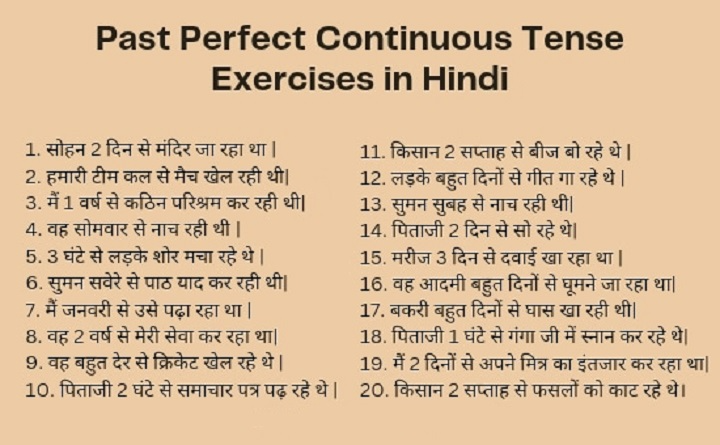
Understanding English tenses is vital for mastering the language, and the past perfect continuous tense is one of the important yet often confusing tenses for learners. If you are a Hindi speaker trying to grasp how the past perfect continuous tense works, this blog will provide you with clear explanations and plenty of examples in Hindi. By the end of this article, you will be able to recognize, form, and use the past perfect continuous tense confidently.
What Is the Past Perfect Continuous Tense?
The past perfect continuous tense describes an action that was ongoing for some time before another action or time in the past. It focuses on the duration of the activity that was happening continuously until a certain point in the past.
Structure of Past Perfect Continuous Tense
- Subject + had been + verb (base + ing) + object/complement
This tense highlights that an action started in the past, continued for a while, and was still happening up to another point or event in the past.
How to Form Past Perfect Continuous Tense?
- Affirmative: Subject + had been + present participle (verb+ing)
- Negative: Subject + had not been + present participle
- Interrogative: Had + subject + been + present participle?
Past Perfect Continuous Tense in Hindi Grammar
In Hindi, past perfect continuous tense is often translated by phrases indicating “कुछ समय से … रहा था” which means “had been doing something for some time.” It focuses on the continuity of the action in the past.
Examples of Past Perfect Continuous Tense in Hindi with English Translations

Affirmative Sentences (सकारात्मक वाक्य)
- वह दो घंटे से पढ़ रहा था।
He had been studying for two hours.
- मैं सुबह से इंतजार कर रहा था।
I had been waiting since morning.
- वे पिछले महीने से काम कर रहे थे।
They had been working since last month.
- हम कई दिनों से उस फिल्म को देख रहे थे।
We had been watching that movie for several days.
- उसने दो साल से अपनी कार ठीक करवाई थी।
He had been repairing his car for two years.
Negative Sentences (नकारात्मक वाक्य)
- वह दो घंटे से पढ़ नहीं रहा था।
He had not been studying for two hours.
- मैं सुबह से इंतजार नहीं कर रहा था।
I had not been waiting since morning.
- वे पिछले महीने से काम नहीं कर रहे थे।
They had not been working since last month.
- हम कई दिनों से उस फिल्म को नहीं देख रहे थे।
We had not been watching that movie for several days.
- उसने दो साल से अपनी कार ठीक नहीं करवाई थी।
He had not been repairing his car for two years.
Interrogative Sentences (प्रश्नवाचक वाक्य)
- क्या वह दो घंटे से पढ़ रहा था?
Had he been studying for two hours?
- क्या मैं सुबह से इंतजार कर रहा था?
Had I been waiting since morning?
- क्या वे पिछले महीने से काम कर रहे थे?
Had they been working since last month?
- क्या हम कई दिनों से उस फिल्म को देख रहे थे?
Had we been watching that movie for several days?
- क्या उसने दो साल से अपनी कार ठीक करवाई थी?
Had he been repairing his car for two years?
When to Use Past Perfect Continuous Tense?
- To show that an action was happening for a period of time before another past event.
Example: I had been sleeping when the phone rang.
(फोन बजने तक मैं सो रहा था।)
- To emphasize the duration of a past action up to a certain point.
Example: They had been playing football for an hour before it started raining.
(बारिश शुरू होने से पहले वे एक घंटे से फुटबॉल खेल रहे थे।)
- To explain cause and effect related to a past continuous action.
Example: She was tired because she had been running.
(वह थकी हुई थी क्योंकि वह दौड़ रही थी।)
Key Points to Remember
- Past perfect continuous tense always uses had been + verb-ing form.
- It is used for actions that continue over a period of time before another past action.
- Hindi translations often include “कुछ समय से … रहा था” to express this tense.
- Helps show the ongoing nature of an action in the past with emphasis on duration.
FAQs About Past Perfect Continuous Tense in Hindi
Past perfect continuous tense क्या होता है?
यह वह काल है जिसमें हम किसी ऐसी क्रिया को व्यक्त करते हैं जो पिछले समय में किसी अन्य क्रिया से पहले कुछ समय से जारी थी।
Past perfect continuous tense का ढांचा क्या है?
Subject + had been + verb (ing) + object/complement
Hindi में इसे कैसे व्यक्त करते हैं?
आमतौर पर इसे “कुछ समय से … रहा था” के रूप में अनुवादित किया जाता है।
इसका प्रयोग कब करना चाहिए?
जब किसी कार्रवाई की अवधि और निरंतरता को पिछले किसी विशेष समय या घटना से पहले दर्शाना हो।
क्या past perfect continuous tense और past continuous tense में फर्क है?
हाँ, past continuous किसी समय पर चल रही क्रिया बताता है जबकि past perfect continuous वह क्रिया बताता है जो किसी और क्रिया से पहले लगातार चल रही थी।
The past perfect continuous tense plays a crucial role in expressing the duration and continuity of past actions before another past event. Hindi speakers can master this tense by understanding its structure and practicing examples like those provided. Using this tense correctly will make your English communication more precise and natural.